How Does Root Test Drive Know if You Are a Passenger
Baseball is a game of numbers. So much then that the Major League Baseball site features 72 standard stats which "assist tell the tales of the game millions dear."
One of the oldest and most universal tools to mensurate a hitter's success at the plate is batting average, which was adopted in the belatedly 19th century by Henry Chadwick, an English statistician raised on cricket. The stat is adamant past dividing a role player'due south hits past his total at-bats (a player's turn at batting) for a number betwixt nil (shown as .000) and i (1.000). But according to the site, batting average lone isn't enough since information technology doesn't take into account the number of times a batter reaches base via walks or hit-by-pitches, and information technology as well excludes hit types (double, triple or home run are more valuable than a single).
And so, in 1984, on-base per centum (OBP) became an official MLB stat. OBP refers to how often a batter reaches base per plate advent. Times on base include hits, walks and striking-by-pitches, just do not include errors, times reached on a fielder's selection or a dropped third strike. Since a hitter's goal is to avert making an out, on-base percentage shows which hitters have achieved that task the all-time, and co-ordinate to the site, in that location aren't many meliorate basic evaluative tools than on-base of operations percentage. Only basic is but basic.
So, long after it was first invented, slugging percentage started to brand waves. The stat represents the total number of bases a player records per at-bat. Unlike on-base percentage, slugging percent deals only with hits and does not include walks and hitting-by-pitches in its equation. Slugging pct exists mainly due to a noticeable flaw in batting boilerplate – not all hits are created equal. In batting average, a single and a home run are valued the same and with slugging percentage dwelling house runs are counted four times as much as each single. Simply that doesn't hateful slugging per centum is flawless – for instance, the stat considers a double to be worth exactly twice as much as a single and that isn't accurate in the context of scoring.
Since OBP and slugging percentage alone aren't enough, John Thorn and Pete Palmer popularized on-base plus slugging (OPS), which combines the 2 stats. OPS is used to determine how well a hitter can reach base, with how well he can hit for average and for power. Batting average, on-base of operations percentage and slugging pct all accept basic flaws, which don't exist in OPS. As a issue, OPS is widely considered one of the all-time evaluative tools for hitters according to mlb.com. Merely one of the all-time isn't the best – OPS values on-base and slugging pct equally and in reality, a point of on-base percentage is worth more than toward a squad'southward run expectancy than a indicate of slugging percentage.
In his book, Moneyball: The Fine art of Winning an Unfair Game, author Michael Lewis dedicates a chapter to Nib James, a writer, historian, statistician, and above all an obsessive baseball fan: "I didn't care about the statistics in annihilation else," he wrote in his 1985 Baseball Abstruse. "I didn't, and don't pay attention to statistics on the stock market, the weather, the offense rate, the gross national product, the apportionment of magazines, the ebb and menstruation of literacy among football fans and how many people are going to starve to death before the year 2050 if I don't start adopting them for $3.69 a month; just baseball. Now why is that? It is considering baseball statistics, unlike the statistics in any other area, accept acquired the powers of language."
The first edition of Pecker James' Baseball Abstract was self-published in 1977, featuring 18 categories of statistical information throughout 68 page. 75 people purchased the booklet after an advert was placed in The Sporting News, and in 1978, he sold 250 copies of the 2nd edition titled Baseball's Most Informative and Imaginative Review. Beak James went on to coin the term sabermetrics (the name derives from SABR, the acronym of the Society for American Baseball Research), defining it as "the search for objective knowledge nigh baseball." And today, in that location are more than 6,000 SABR members around the world who use statistical assay "to question traditional measures of baseball evaluation."
Neb benefited from two important occurrences at the time; baseball players were earning more and computers became more advanced. In the 1980s, Ken Mauriello and Jack Armbruster were coworkers at a big trading firm in Chicago that studied the price of bolt in various financial markets. After the company did well by capturing the inefficiencies of the market, Ken and Jack decided to utilize the same concept to baseball. While the two made their beginning sales trip effectually Major League Baseball game, they met Paul DePodesta, and so an intern for the Cleveland Indians who had majored in economics at Harvard. Fast-forward to 1998, Paul joined the Oakland Athletics as an banana director and convinced Baton Beane, then the full general manager of the society, to rent the two and the remainder is Hollywood history:
There'southward a debate on whether or non baseball game is a true team sport. Unlike basketball where Russell Westbrook can impact his teammates by a sure style of play, baseball is more of a western standoff between a pitcher and a batter. For 3-time World Series champion Pete Rose, baseball is a bit of both – "baseball is a team game, but nine men who attain their individual goals brand a nice squad." And since baseball has a lot to exercise with individual performance, personalized information and assay are crucial for building a great team of individuals.
Similar to baseball, insurance is also a alloy of individual and team. Insurance companies collect premiums from a group of policyholders, but claims are made and paid individually. So while there is a group effort, insurance companies put a lot of accent on personalized underwriting to form a great grouping of individuals.
If there's one insurance visitor that's all about data and analytics it would be Root Insurance . With ~$177m in funding and a $1b valuation, Root is on a mission "to transform the car insurance globe and reinvent a broken industry from the footing up." Using technology in smartphones to measure driving behavior such equally braking, speed of turns, driving times, and road regularity, Root determines who is a safety commuter and who isn't, and by only insuring safety drivers, the company can offer its customers more affordable rates. According to its site, during the test drive, Root uses several methods to measure driving beliefs:
- GPS – Used someday when Google maps or other navigation apps are opened. In addition to latitude and longitude, the GPS collects data like speed, distance, and the direction a person is heading
- Accelerometer – Used to notice the acceleration of the phone and can reveal if a person is accelerating too quickly or slamming the brakes besides hard
- Gyroscope – Used to help the accelerometer with understanding the way a phone is positioned. Information technology is the applied science that allows your telephone to detect when to switch views from vertical to horizontal and vice versa
- Magnetometer – Used to help the accelerometer and gyroscope observe the smartphone's orientation, measuring the telephone'southward relation to the World'due south magnetic field
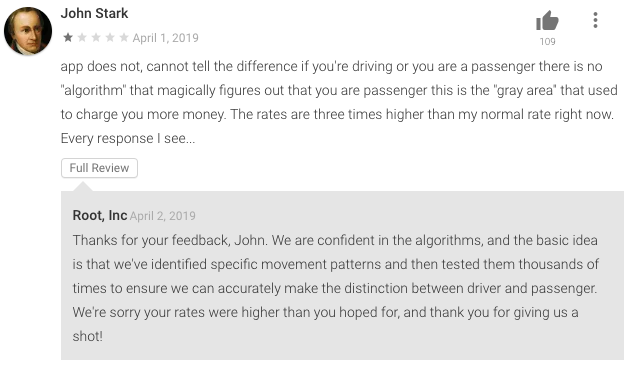
According to Root, all of the data collected through these instruments are put into an algorithm that accurately determines the movement of one's phone. Now, comes the million-dollar question: How tin can Root distinguish a commuter from a rider? In its site, Root explains that the movement of your phone is different when you're the driver than when you're a rider. However, several users complained that Root isn't able to accurately tell the difference.
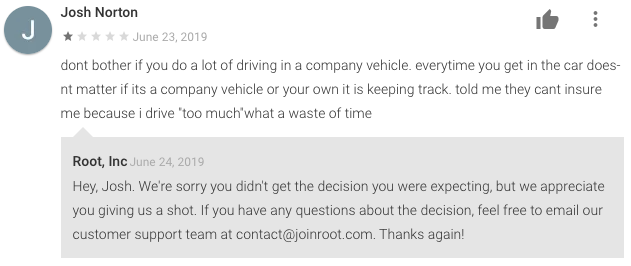
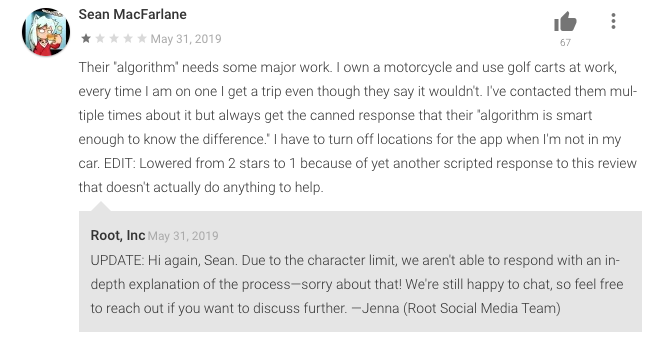
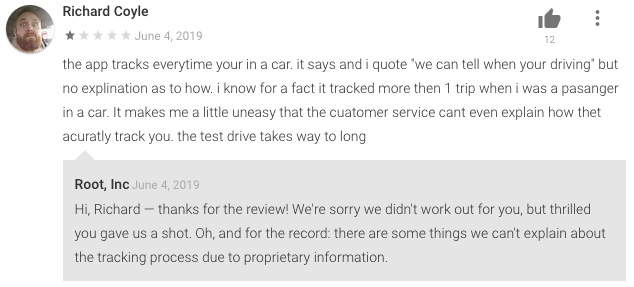
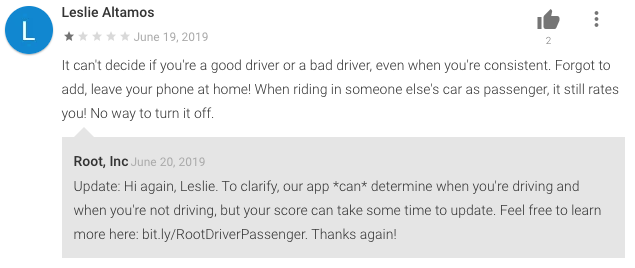
The @joinroot concept is great just it'south definitely counting others' driving confronting me. Didn't drive for a full week and my score went down.
— Petty Proud (@torisneaux) April 22, 2019
It took my all-time friends driving as mine and she's not the best! 😂 I hope that doesn't touch me!
— Ashley Reyes (@ashleydearrr) March 30, 2019
Related, @joinroot is intriguing, only I really don't run into how their app can tell the divergence between driver and passenger if my habit is to put my phone somewhere else when I'm driving.
— Daniel Marcin (@daniel_marcin) February 20, 2019
Despite all the complaints, Root'south response is always the same – information technology can accurately detect whether a person is a driver or a passenger. Only that is inaccurate. At that place is no way sensors tin can accurately discover who's driving. Here are but a few examples:
- Your partner is driving and easily yous his/her phone to enter the location in the GPS app. The sensors would determine that the driver was using the phone while driving
- Yous take an Uber or drive with someone else. Sensors cannot detect if yous've entered the passenger's seat
I reached out to Cambridge Mobile Telematics (CMT), the Softbank-backed company with over $500m in funding, and asked a technical question – tin smartphone sensors accurately detect who's driving? I received a response from Hari Balakrishnan, the company's CTO and a professor at MIT'south Computer science and Artificial Intelligence Laboratory, with the aid of the visitor'south VP of insurance, Ryan McMahon: "The case of a passenger using a driver's phone is complicated and no one has completely solved information technology. Our all-time approach so far is to allow the user to flag the bulldoze as 'I wasn't using the phone, but I was the driver'". But it's not just the example of a passenger using a driver'southward phone – using merely sensor data in an effort to decide which side of the vehicle the user got in or out of tends to be "highly noisy" and does not work well. Merely dissimilar Root which doesn't offering users the ability to label each trip, CMT offers a way for users to signal whether they were driving or not, leading to increased accuracy. And because of these challenges, several CMT insurance clients prefer to just capture smartphone sensor data when the DriveWell Tag is present in the user's vehicle, which solves the trouble of a user riding in other cars.
When I reached out to Root with a similar technical question, I received the following response: "Root uses machine learning algorithms to place patterns in the location and motion data we receive from our customers' phones once they've downloaded the Root app. Those patterns are different based on whether they are driving a car or are a passenger. They also change for other modes of transportation. Terminal driving scores are based on actual driving behavior, with our algorithms having filtered out not-driving data after the app picks up motion." And when I gave a real-life example of how different people may have different patterns, I received the post-obit answer: "Information technology's certainly the instance that sometimes the data we collect is imperfect, and that we won't take a perfect view into the full context of what is going on. Seeing the earth through the limited lens of the available data and making inferences is function of the claiming. However, even in the case illustrated, it may be the example that at that place are very slight differences in the phone motion between these 2 cases at dissimilar points in the trip. Further, at that place are boosted contextual pieces of data across but the phone'southward movement that tin can help inform our inferences, such as where and when the trip occurred. We don't claim to be perfect every time, simply we are always improving our models, and we feel that these sorts of distinctions are much fairer to the consumer than the totally demographics-based pricing they might run into from other insurers."
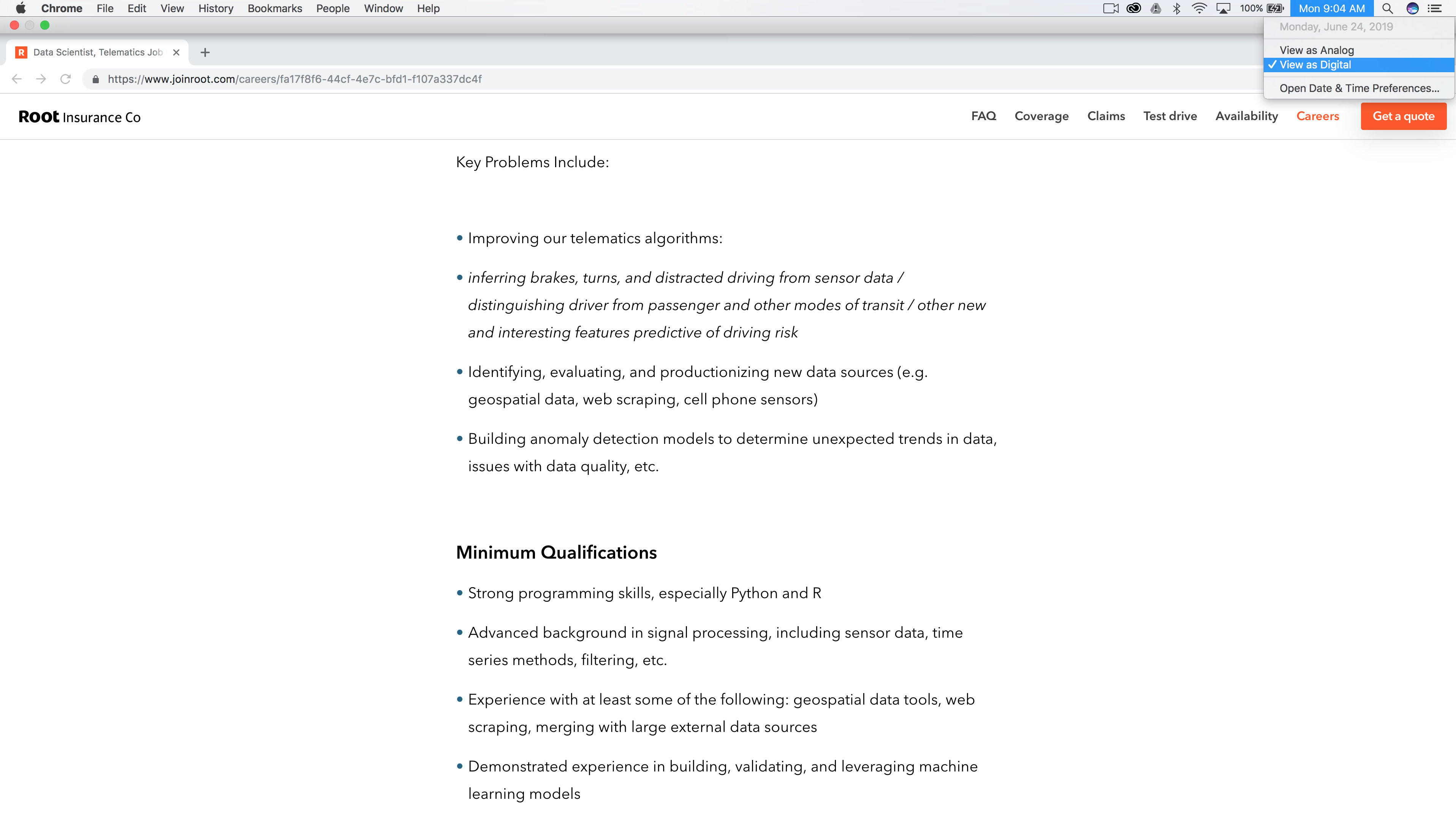
While Root doesn't merits to be perfect, information technology certainly does pigment a perfect film to the public. From their response to users raising questions well-nigh the accuracy of the test drive to their 2019 Focused Driving Report, the company does not indicate that their information and assay may be imperfect. And they conspicuously have several "fundamental bug" every bit described in this Data Scientist, Telematics job advertising:
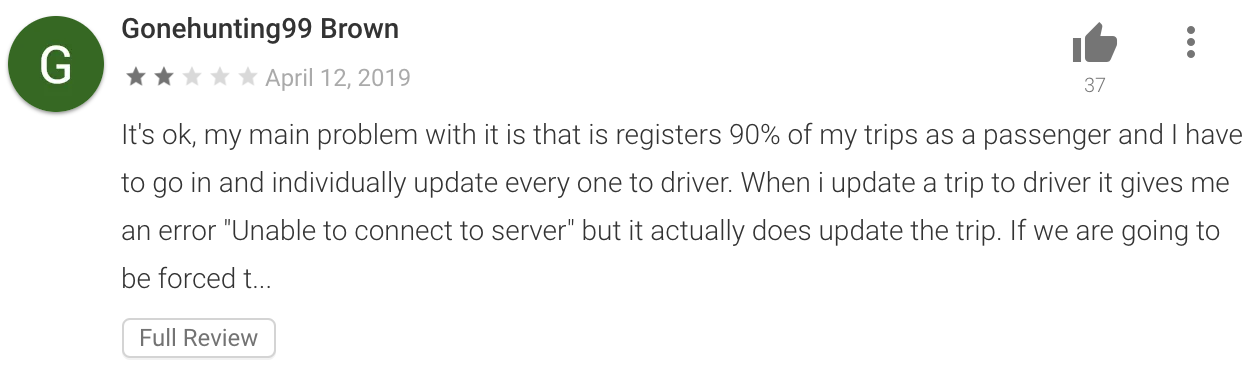
But Root is not alone. Progressive's Snapshot, which allows customers to choose between a mobile app and a plug-in device to measure how they drive, isn't entirely accurate when relying merely on smartphone data:
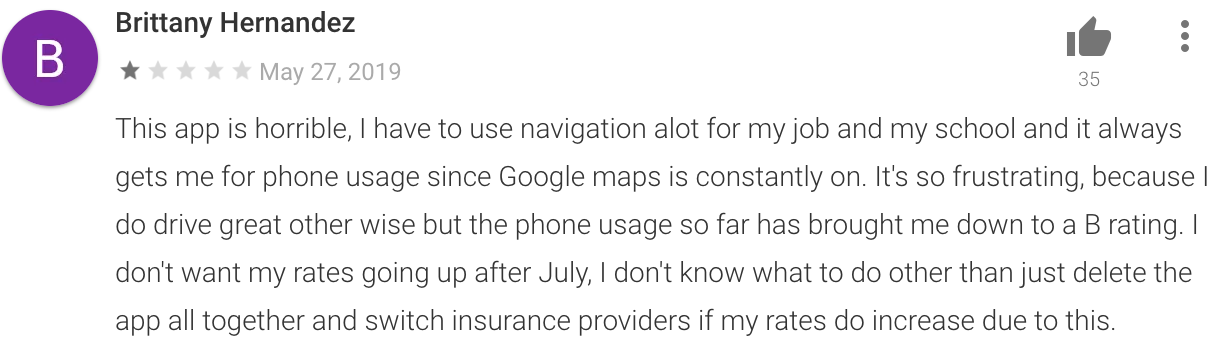
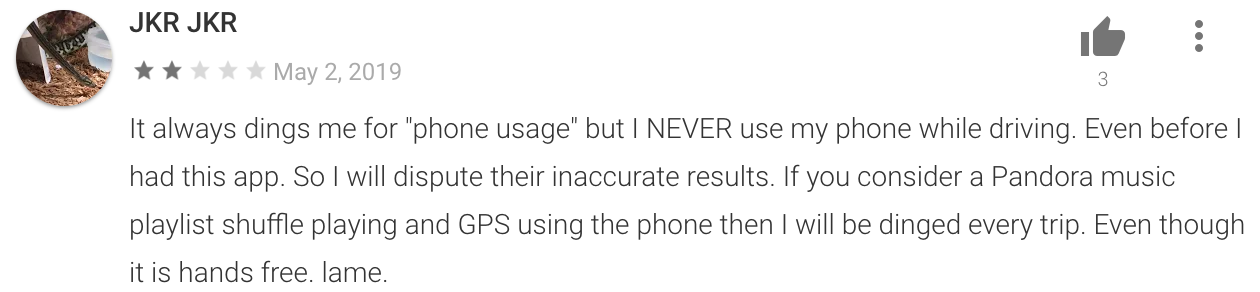
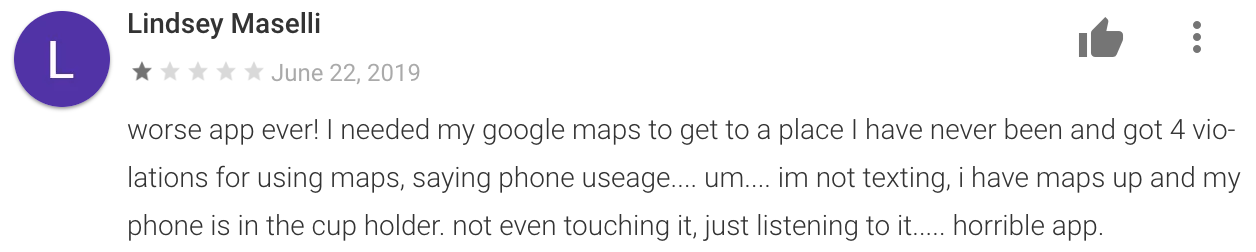
And there are also several complaints of the app considering listening to music through the smartphone or using Google Maps hands-free every bit a distraction:
While insurance companies experiment with telematics, they should keep an open eye on the auto industry. More and more than automakers are adopting connected car technologies, and with the utilize of their in-vehicle cameras they volition be able to accurately detect who's driving and go unique insights on distracted and fifty-fifty intoxicated drivers.
In The Ballad of Bill James, Joe Posnanski describes how the father of sabermetrics never actually believed that he had figured it out. "We will never figure out baseball. We volition never get close to figuring out baseball." Different formulas tell a different story simply before you tin can publish your story, yous demand to make sure the data behind it is authentic.
Source: https://coverager.com/roots-key-problems/
0 Response to "How Does Root Test Drive Know if You Are a Passenger"
Post a Comment