Separate Is Never Equal: Sylvia Mendez & Her Family's Fight for Desegregation
Reviewed by Lila Quintero Weaver
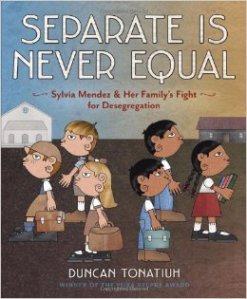
Description OF THE BOOK: When her family moved to the town of Westminster, California, young Sylvia Mendez was excited about enrolling in her neighborhood school. But she and her brothers were turned away and told they had to attend the Mexican school instead. Sylvia could not understand why—she was an American citizen who spoke perfect English. Why were the children of Mexican families forced to attend a separate school? Unable to get a satisfactory reply from the school board, the Mendez family decided to take matters into their own easily and organize a lawsuit.
In the cease, the Mendez family's efforts helped bring an end to segregated schooling in California in 1947, seven years before the landmark Supreme Court ruling in Brownish 5. Lath of Didactics concluded segregation in schools across America.
Using his signature illustration style and incorporating his interviews with Sylvia Mendez, besides as information from courtroom files and news accounts, Duncan Tonatiuh tells the inspiring story of the Mendez family's fight for justice and equality.
MY TWO CENTS: Kudos to Duncan Tonatiuh for shining a bright spotlight on a consequential, just often overlooked chapter of American civil rights, and bringing this true story of Latinos fighting for racial justice to young readers. The volume features Tonatiuh's trademark, award-winning illustration and his retelling of the facts.
In the mid-1940s, when the action takes identify, Sylvia Mendez is ix years quondam. She'southward the daughter of Gonzalo Mendez, a Mexican-born, naturalized denizen of the United States, and his wife, Felicitas, from Puerto Rico. When the Mendez family moves from Santa Ana, California, to a farming community in Orangish County, Sylvia and her brothers are not permitted to enroll in the neighborhood schoolhouse and are instead sent to a school designated for Mexicans, which is farther from home. Unlike the white children'due south school, it's dirty, crowded and lacks a playground. The students eat lunch outdoors next to a fly-infested cow pasture. To top it off, the teachers seem indifferent, as if Mexican children weren't worth the carp.
The Mendez family launches a campaign to demand equal education for their children. Sylvia'due south father beginning pursues answers from officials all the fashion up the line to the board of education, but no one offers a apparent explanation. The common refrain is "that is how it is done." Mr. Mendez organizes members of the Mexican community and hires a lawyer to challenge the discriminatory practices in court. Young Sylvia is in the courtroom during the proceedings, where she hears statements by a school official near the supposedly lice-ridden, junior nature of Mexicans. It takes two court cases to settle the upshot. The gauge's final ruling states that "public didactics must be open to all children by unified school association regardless of lineage."
Afterwards Sylvia's parents successfully face down California's version of Jim Crow laws, she enrolls in the neighborhood school, shattering longstanding colour barriers. In the corresponding folio spread, a white boy tells Sylvia, "You don't vest here," and Sylvia is shown with a bowed head and a tear sliding downwards her cheek. Reminded past her mother of the long fight they undertook to win her right to equal schooling, Sylvia perseveres, proving herself as steely every bit her parents. In the closing pages, she and other brown-skinned children are shown side-by-side with white classmates in the school playground.
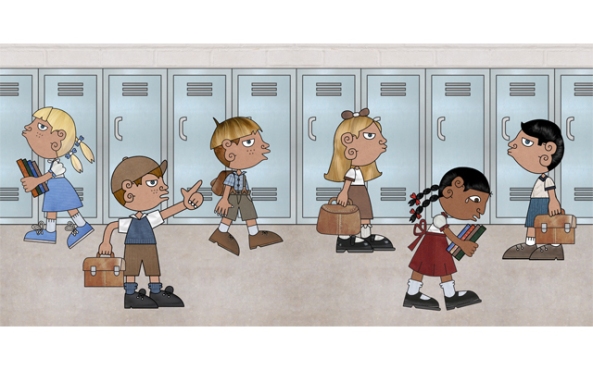
Tonatiuh'southward account highlights the exemplary grapheme of Mr. and Mrs. Mendez. Every motility for justice has its heroes and pioneers, and the Mendez family richly deserves that level of recognition. Taking upwardly the fight involved considerable personal risk. They used their life savings to kickstart the legal fund. Eventually, they received wider support. Leading the accuse took Mr. Mendez away from the farm for long stretches, leaving Mrs. Mendez to perform farming tasks that her married man usually would have handled. As the story shows, many Mexican families in the customs declined to join the lawsuit, for fear of economic retribution. "No queremos problemas," they said.
The California entrada for educational equality, spearheaded by the Mendez case, ultimately led to the 1954 ruling on Chocolate-brown v. Board of Teaching. The victory illuminated by Divide is Never Equal belongs in a articulate line of prominent milestones of American civil rights. How fortunate that someone with Tonatiuh's skill has brought it out of the shadows.
TEACHING Resource: Across the importance of the story, Tonatiuh'southward groundbreaking illustrations deserve readers' attention. His drawings marry childlike innocence with characteristics of ancient Mixtec art. (See my review of Pancho Rabbit and the Coyote: A Migrant's Tale for a fuller discussion of his style.) In Separate is Never Equal, the illustrations have on the added dimension of historical details from the 20thursday century. Teachers may want to provide students with photographs from the era to demonstrate how carefully Tonatiuh researched and reproduced clothing, hairstyles, auto models, and other authenticating markers of the 1940s.
Equally is by and large the case with nonfiction picture show books, younger readers volition likely demand adult guidance to sympathise sections of the story that deal with legal proceedings and other points of the Mendez'south battle.
This book presents powerful opportunities for teaching empathy and strengthening awareness of the pain that racism inflicts. One scene shows a public swimming puddle with a sign stating, "No Dogs or Mexicans Immune." Mexican children wait longingly through the fence at the white children frolicking in the pool. Teachers can pose discussion questions such equally, "Imagine yourself on both sides of the fence. How would yous feel in either situation?" Consider comparing Sylvia Mendez's experiences with those of Cherry Bridges, the young African American girl who integrated New Orleans schools in 1960.
A department in the dorsum of the book includes an author's annotation, a glossary, a bibliography and explanatory details near methodology. Much of Tonatiuh's research came from court documents and all-encompassing interviews with Sylvia Mendez. Glossary entries include a handful of Spanish phrases used in the volume and historical terms that round out the context. One example is the origin of "carve up only equal," a phrase plucked from the 1896 ruling by the U.Southward. Supreme Courtroom in the Plessy v. Ferguson case, which laid the foundation for decades of Jim Crow laws.
In 2010, Sylvia Mendez received the Presidential Medal of Freedom. She is interviewed on this video, which highlights points of the story told in the book and shows photographs of her as a child and of the schools in question.

Duncan Tonatiuh was built-in and raised in Mexico. He studied art in the U.s.a.. His flick volume Pancho Rabbit and The Coyote: A Migrant's Tale won the 2014 Tomás Rivera Mexican American children'south book honor, and two honors for text and illustration from the Pura Belpré Award. Read more than about Duncan on his official website.
Source: https://latinosinkidlit.com/2014/11/06/libros-latins-separate-is-never-equal-sylvia-mendez-and-her-familys-fight-for-desegregation/
0 Response to "Separate Is Never Equal: Sylvia Mendez & Her Family's Fight for Desegregation"
Post a Comment